
Myungri · Space
Myungri: The Missing Layer in Interior Design
Myungri-Based Space Design, Interior Design, Spatial Design
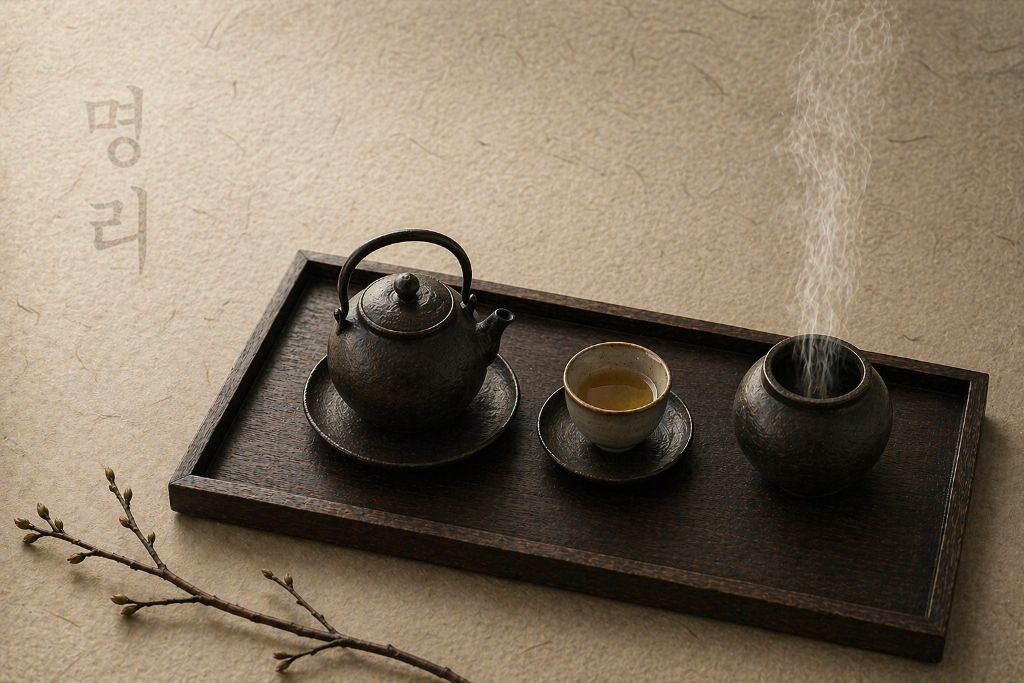
Myungri (命理), a term rooted in classical Chinese characters, carries the meaning of "the principle of discerning the inherent pattern given to one's life."
This concept holds a layered meaning that resists translation into a single English word, encompassing notions such as destiny, fate, doom, and fortune.
Its ultimate purpose lies in understanding the limits given to one's life and finding the most balanced state within them.
Within this framework, no simple, secular judgment of good or bad is imposed.
This system is understood to have taken shape in the Chinese region approximately 2,000 years ago, with historical records preserving the names of scholars who developed its theory across successive periods.
Today, however, within a communist framework, China approaches it from the perspective of "traditional cultural heritage," with research centered on textual restoration and historical interpretation.
Within a collectivist social structure, an environment in which individual life paths and personal choices receive less emphasis may also have influenced this direction of development.
In contrast, Korea, alongside its broader development across multiple fields, has actively engaged with this classical system— reinterpreting it and applying it to modern life and industry.
It has achieved a distinct level of advancement within practical and applied domains.
In addition, the logic of classical Myungri has been integrated with modern disciplines such as psychology, counseling, and management, with a focus on interpreting human relationships and the structure of life in a more systematic way.
To support this, the field has been formally incorporated into institutional education, with research frameworks extending from undergraduate studies through master's and doctoral programs, establishing a clear direction centered on how this system can be applied.
As a result, Myungri has developed beyond interpretation into a refined system for analyzing the flow of life, extending further into what may be understood as a field of predictive studies.
For this reason, my interpretation of Myungri is grounded in the Korean interpretive framework.
One of the key areas in which this system is applied is spatial design.
This approach, centered on the individual, engages more deeply with the user's internal state.
By analyzing the unique structure of one's inherent energy, it seeks to organize and refine its flow through adjustment and supplementation, with the aim of creating an environment that supports both psychological and physical stability.
While conventional design is constructed around visually validated elements, a Myungri-based approach interprets and applies those same elements differently according to each individual's structure and state of balance.
As a result, space moves beyond form and becomes a system that operates in alignment with the individual.
This ancient body of practical wisdom, with a depth comparable to contemporary scientific frameworks, continues to function meaningfully in modern life.
As someone who has built long experience in this field, I hope that this wisdom, no longer confined to the East, will be applied more broadly across the world— supporting a more stable and enriched life for modern individuals.